Cycles in the Tech Industry
Boy, do we love trends in tech. I mean… we love trends in tech. I’m old enough to remember desktop publishing, and client-server networks. I remember when the LAN was the thing. Then the World Wide Web ushered in a brand new wave of connectivity, and legitimately opened ways for ordinary people to have a public voice they didn’t really have before. With that came a huge wave of startups and the first mega-properties (Yahoo, especially) online. This is the time period where I got started as a youngster in college.
Remember desktop publishing? It morphed into blogging, which is when I registered this domain and began the initial versions of this site.
Those cycles kept coming. E-commerce with its early poster children eBay and PayPal, and later, Amazon (which leans into the whole point of this ramble, bear with me….), then devops, then cloud computing, then containers, and now it’s AI (which, for a while was “agentic” but now it’s just back to AI)…..
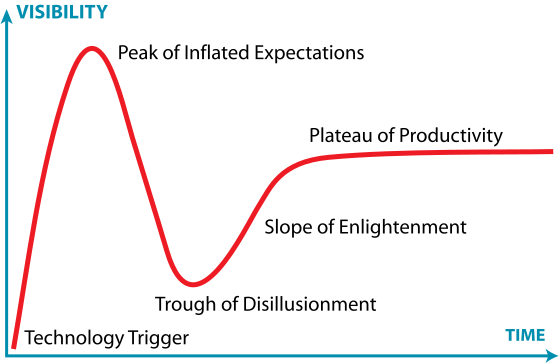
Gartner Hype Cycle by Jeremy Kemp, CC BY-SA 3.0, via Wikimedia Commons

In every cycle, there’s hype, there’s doom, and there’s the eventual settling into normality. After the Gartner Hype Cycle moves past the Plateau of Productivity, there comes the Downward Slope of Value Extraction as the tech becomes commoditized, ubiquitous, and investment capital squeezes the last few drops of juice left and we get to Cory Doctorow’s famous enshittification. Which is what Broadcom’s currently doing to VMware…. which strangely brings me back to the whole point of this post.
Management Trends Cycle, Too
My first participation in a major layoff was at Dell Software Group - they had acquired enStratus (then enStratius), a really cool automation/cloud management platform that was ahead of its time - and Dell was adjusting its books to get ready for what was hyped at the time as the largest transaction of wealth in the history of humanity to acquire (see how this is coming around? I ramble, but I do land the references eventually) EMC, and its crown jewel - VMWare.
Layoffs happen, and often for good reason. The fact that I was handed an axe in that transaction makes sense.
More recently, however, we’ve got a series of misguided trends in tech management groups. Right now, most larger tech companies run layoffs annually. Because….. everyone else is running layoffs annually. This got started when Elon Musk of PayPal fame (see? Cycles, and references. It’s spirals all the way down, folks) acquired Twitter and almost immediately laid off a big chunk of its staff. Conventional wisdom said that particular layoff was due to Covid-era overhiring, but honestly it was a management move to get the staff onboard with his newer plan for the company - run it as thinly as possible without the whole thing falling over, and remove content governance. But the lockdown “overhiring” sure was the excuse the industry made at the time. That set this silly trend going of regular layoffs, with most companies re-hiring new employees to fill the gaps they just made. Which is awkward, because new hires cost money both in hiring costs as well as the opportunity costs of lost tribal knowledge. Might as well have just kept the staff you hired in the first place, and hire more carefully to make sure people fit the skills and culture.
Now they’re laying off people “because of AI.” What I’ve learned is that AI doesn’t replace people - it augments them, and to do AI right you need to be disciplined with your engineering documentation to feed your agents. That takes people, and the right ones.
I was laid off at the beginning of September from my job at PagerDuty. Oddly, I think this one’s actually for business alignment reasons, not just generic annual layoffs, which I managed to avoid several times there. Oracle just announced they’re cutting a lot of staff. I’m pretty sure this trend is because tech c-levels don’t really talk to anyone outside of their own peer group, and they get into a big funk of groupthink. I could be wrong. It does happen. Not often, though. ;P
We’ve got other anti-patterns in the tech industry too, like the increasing focus on in-office jobs and lack of remote ones…. especially in the AI industry where the biggest players are hemorrhaging staff due to stress, partially due to the immense pressure that comes from working inside the hype bubble. I’ve been there. It’s rough.
Take care of yourselves, friends. Don’t let the gotchas getcha.
“Don’t go jumping off a bridge just ‘cause everyone else is.” - My Mom